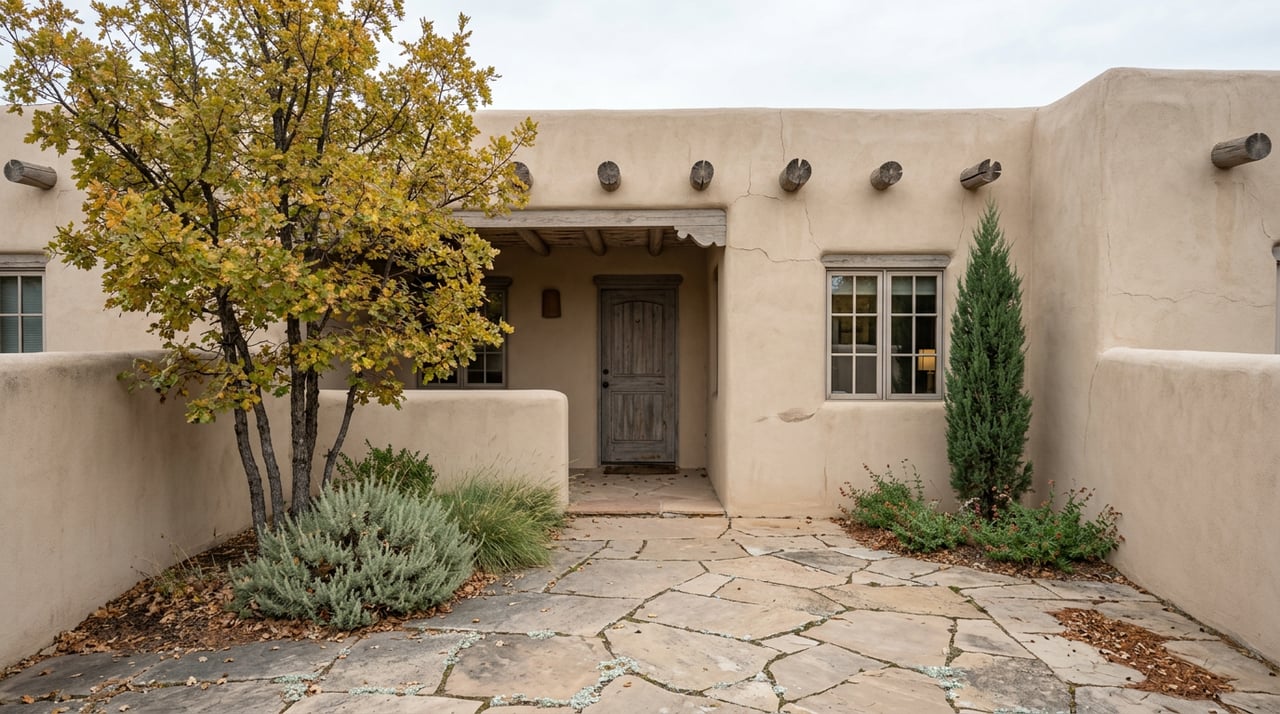
Ask most sites what Canyon Road is, and you get the same sentence, reordered: a half-mile of adobe buildings holding more than a hundred galleries, restaurants, and boutiques. True, and useless if you already walk it every week. What that sentence never mentions is that Canyon Road actually keeps two separate calendars running at once, one built for visitors who show up once and one built for the people who live within earshot of the acequia, and this month both calendars happen to close on the exact same date.
That date is September 20. If you live in the Historic Eastside, the next thirteen days are the only window you'll get to see two unrelated exhibitions before they both come down together.
Two Calendars, One Closing Date
The visitor-facing version of Canyon Road is steady by design. Galleries open at 10 and close at 5, seven days a week, and the street's identity gets refreshed for tourists every season with the same rotating cast of adjectives. The resident-facing version moves differently. It tracks openings, closings, and the handful of nights a year when the street changes its own rules, from the informal Summer Walks that have run from June into October in recent years, organized by Santa Fe native Maggie Fine as a warm-weather counterpart to the winter tradition, to the single night in December when the whole street shuts to cars.
Right now you're standing at the seam between those two calendars. Turner Carroll Gallery, at 725 Canyon Road, is holding two exhibitions that happen to share a closing date. Shepard Fairey's show, Cultivate Justice, was originally scheduled to run from mid-July through early August and got extended into a condensed format through September 20. Alongside it, the gallery opened the Christo and Jeanne-Claude Family Collection in mid-August, also closing September 20. Two artists with almost nothing in common, sharing one wall for a little under two weeks, and then gone.
What's Actually On the Walls Right Now
If you've walked past Turner Carroll without stopping in months, this is the reason to go before the end of the month. The gallery describes the pairing as a rare chance to see Fairey's politically charged street-art lineage next to material drawn from the Christo and Jeanne-Claude family's own collection, work that doesn't often travel to a single Canyon Road storefront at the same time.
A few blocks down, Canyon Road Contemporary Art relocated a short distance from its original spot to 409 Canyon Road, a move worth knowing if your mental map of the street is a few years stale. It's a small detail, but it's the kind of detail that separates someone who actually walks this street from someone reading a directory. The gallery still shows the eclectic mix it built its reputation on, paintings, sculpture, glass, and metalwork from a global roster of emerging and established names, just under a different awning.
Before the overlap closes, here's what's on the walls worth the walk:
- Turner Carroll Gallery, 725 Canyon Road: Shepard Fairey's Cultivate Justice, extended through September 20 in a condensed format
- Same gallery, same closing date: the Christo and Jeanne-Claude Family Collection, on view since mid-August
- Canyon Road Contemporary Art, now at 409 Canyon Road, a few doors from its original location
Miss the window and both shows come down together. The street resets, as it always does, into whatever fills the space next.
The Errand Route Under the Cottonwoods
Not every walk down this street is about galleries. The neighborhood's other rhythm, the one that has nothing to do with art openings, runs along the Acequia Madre, the four-hundred-year-old irrigation ditch that still carries water and still gives the street its name. Follow it east from Canyon Road and you pass Downtown Subscription, at 376 Garcia Street, open seven days a week from 7 in the morning until 4 in the afternoon, the kind of place where the coffee line moves slowly because half the people in it know each other. A little further along sits Johnnie's Cash Store, doing business since 1946 at 420 Camino Don Miguel, the closest thing this neighborhood has to a corner store, still selling cold drinks and tamales out of a building that hasn't pretended to be anything else in eighty years.
The acequia walk is short enough to do before coffee gets cold. A giant redwood, the only one of its kind in the neighborhood, marks the turn toward Garcia Street. Past it, the ditch runs on toward Canyon Road and empties out at Patrick Smith Park.
That park, a five-acre stretch of grass and cottonwoods bordered by the Santa Fe River, is the neighborhood's actual backyard, the place where dog walks happen and where the basketball courts stay busy long after the galleries have closed for the night. A block or two over, El Zaguán, the adobe compound that houses the Historic Santa Fe Foundation, is a quieter kind of landmark, the sort of building that reminds you the whole street was residential before it was commercial, dating back to a Santa Fe merchant who connected several structures into one family home in the 1850s.
None of this shows up on the gallery-hopping map most visitors carry. It's the part of the neighborhood that keeps functioning at 8 a.m. on a Tuesday, long before the first shop door on Canyon Road unlocks.
When the Second Calendar Ends
The Summer Walks that have animated Canyon Road on recent warm-weather evenings, drawing crowds for live music and food trucks between gallery stops, wind down as October arrives. When they do, the street quiets in a way that catches newer residents off guard. The tourist traffic thins, the evening events stop, and Canyon Road settles into the stretch of the year with the fewest reasons to be out after dark, right up until the one night that reverses everything.
That night is Christmas Eve, when the Canyon Road Farolito Walk turns the same quiet street into the most crowded stretch of pavement in the city. In past years, police have closed Canyon Road and the streets around it, including sections of Acequia Madre and Paseo de Peralta, starting around 5 in the evening, with free shuttle buses running from the South Capitol Rail Runner Station to help manage the crowds. It's the one date on the calendar where the visitor version of Canyon Road and the resident version become the same event, thousands of people walking a street residents usually have mostly to themselves.
Between now and then, the street belongs to whoever already lives close enough to notice it. Two shows close September 20. The summer walks fade out behind them. The acequia keeps running regardless, past the redwood, past Johnnie's, into the park, the way it has for four centuries, on a schedule nobody's directory tracks and nobody's calendar interrupts.
If any of this, the shows, the shifting gallery lineup, or simply the pattern of how this neighborhood moves through a season, ever turns into a conversation about the Historic Eastside itself, Rachele Griego has spent enough time on this street to talk through it property by property, wall by wall.
