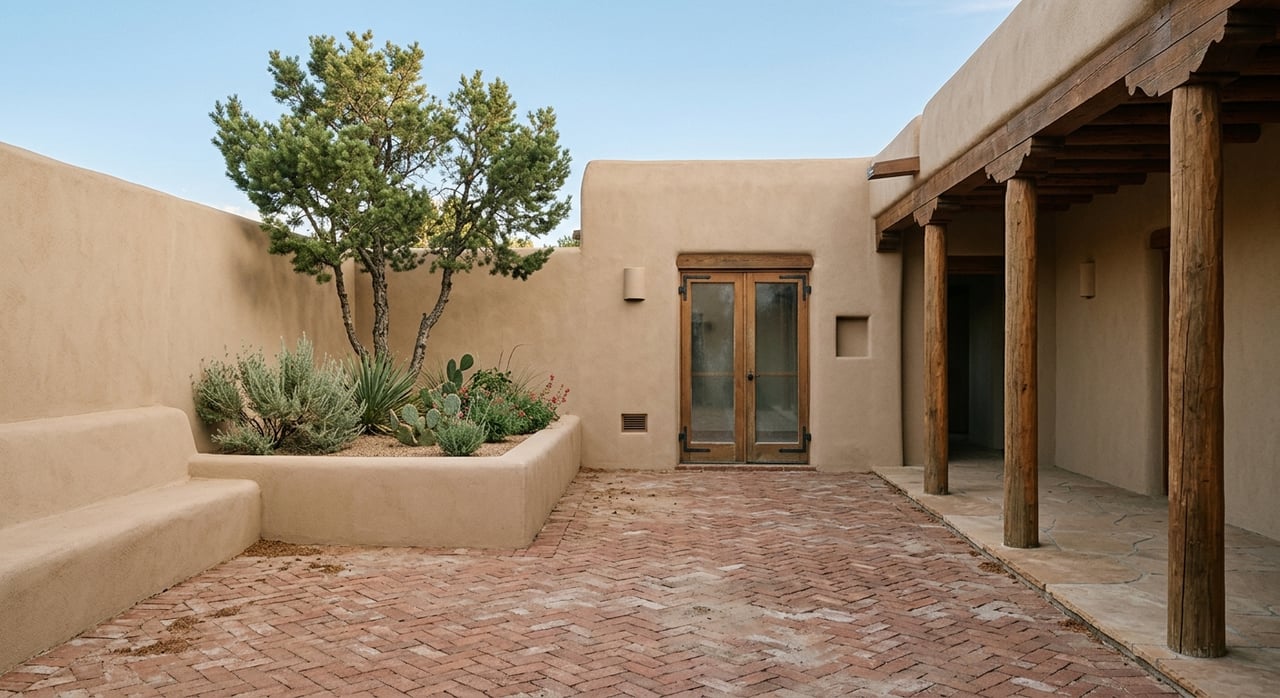
If you picture Santa Fe living as quiet outdoor mornings, thick adobe walls, and a private place to gather just beyond the street, you are already thinking about courtyard living. On the Historic Eastside, that idea is not a trend. It is part of the area’s oldest residential pattern and one of the clearest reasons buyers are drawn here. If you are considering a home in this part of Santa Fe, it helps to understand what makes a courtyard special, what shapes its value, and what to look for before you buy. Let’s dive in.
Why courtyards define the Historic Eastside
Santa Fe’s Historic Eastside sits within the city’s Downtown and Eastside Historic District, which includes areas such as Canyon Road, Acequia Madre, Camino del Monte Sol, and East Palace Avenue. City history materials describe this area as one of Santa Fe’s oldest and most physically intact parts of town. The street pattern is more irregular than in other areas, and old Santa Fe compounds remain a defining feature.
That setting helps explain why courtyards feel so natural here. Many historic adobe homes in the district were built in Spanish Pueblo and Territorial styles, with compounds arranged for privacy and daily life behind walls rather than out toward the street. In the Historic Eastside, a courtyard is often part of the home’s original logic, not an afterthought.
What courtyard living means in Santa Fe
Traditional Santa Fe residential design often placed adobe buildings close to narrow streets with little or no front yard. Instead of opening outward, homes were commonly organized around a central patio or placita. The city’s urban design guidance describes these spaces as private refuges from dust and street noise and as the center of family activity.
That distinction still matters today. A true Santa Fe courtyard usually functions as an outdoor room, framed by walls, gates, portals, and the home itself. It is less about extra yard space and more about enclosure, comfort, and a sense of retreat.
The role of portals and walls
In Santa Fe’s Historic Districts Handbook, a portal is defined as a roofed space outside the main walls of a structure with a depth of at least four feet. In practical terms, portals help make a courtyard usable across more of the year by adding shade and shelter.
Walls matter just as much. The city’s wall and fence guidelines treat courtyard walls as privacy barriers that can enclose courtyards, parking, and other private areas. Those walls are part of the architectural experience, helping shape how the space feels from inside the compound and how it relates to the street.
Why courtyards work so well here
Santa Fe’s climate supports this style of living in a very specific way. NOAA climate normals for the Santa Fe 2 station show an annual average temperature of 50.0°F, an average annual maximum of 64.9°F, an average annual minimum of 35.2°F, 12.79 inches of precipitation, and 20.2 inches of snowfall. That mix points to strong sun, cool evenings, and relatively limited moisture.
For homeowners, that often translates into a real advantage. A well-designed courtyard can capture warmth in cooler months, offer shade in summer, and create a more protected microclimate than an exposed yard. In a place with bright sun and crisp evenings, sheltered outdoor rooms simply make sense.
Landscaping that fits the setting
The city’s design guidance also encourages native, drought-resistant plant material around walls and terraces. That is especially useful in a courtyard, where privacy, moisture control, and low-water planting often need to work together.
A successful Eastside courtyard is rarely just a paved area in the middle of a lot. More often, it feels layered, with planting, walls, seating areas, and portals creating a sequence of spaces that are both practical and inviting.
What buyers should look for
Not every courtyard home offers the same experience. If you are touring homes on the Historic Eastside, it helps to look beyond surface charm and pay attention to how the space actually performs.
Sun, shade, and comfort
Start by noticing how the courtyard receives light throughout the day. In Santa Fe, winter sun can make an outdoor space feel welcoming, while summer shade and wind protection can make it far more usable.
Look at how walls, portals, and the house itself shape the environment. The most comfortable courtyards usually feel protected rather than exposed.
Privacy and enclosure
Pay attention to how the courtyard is framed. Walls, gates, and secondary structures can create a strong sense of privacy, which has long been central to Santa Fe compound living.
City guidelines note that courtyard walls should function as privacy barriers and remain connected to the structure without changing the historic spatial character of a compound too dramatically. In streetscapes with no existing walls or fences, yard walls and fences should not exceed five feet in height.
Drainage and moisture
Moisture is one of the most important issues to evaluate in a historic adobe property. The National Park Service notes that adobe changes with moisture content, and incompatible hard repairs can accelerate deterioration.
When you visit a home, inspect grading, runoff patterns, roof drainage, and irrigation placement. Standing water, poor drainage, or signs of water collecting near walls are important red flags in any courtyard setting.
Materials and maintenance
Historic Eastside homes often carry years of careful repair and stewardship, but they can also show signs of unsuitable updates. Look closely for cracking stucco, patched wall surfaces, parapet concerns, or evidence of overly hard modern repairs.
Adobe homes are maintenance-sensitive, and preservation tends to work best when repairs use compatible traditional methods and materials. A beautiful courtyard should also show signs of sensible long-term care.
Prior approvals for exterior work
Because the Historic Eastside is part of a regulated historic district, exterior work matters from both a design and approval standpoint. The City of Santa Fe requires pre-approval for exterior work in historic districts through the Historic Preservation Division.
Ask whether prior work involving walls, gates, windows, roofs, solar, or stucco was reviewed by the city. The current historic districts application requires a submission packet and carries a $75 initiating fee, and larger changes may go before the Historic Districts Review Board rather than receiving administrative approval.
Why preservation rules shape value
On the Historic Eastside, a courtyard home is not just a style choice. It is also a historic resource shaped by preservation review. The city’s permit information lists common items that may require permits or historic review, including re-roofing, window replacement, solar panels, new or replacement mechanical equipment, re-stuccoing, driveway construction, and features such as fences, walls, and gates.
For buyers, that affects future flexibility. A courtyard may look simple at first glance, but changes to walls, openings, drainage elements, or exterior materials can involve review. Understanding that framework early can help you plan realistically and avoid surprises.
For sellers, this also affects presentation. Homes that feel intact and well stewarded often stand out because buyers can better understand both the character of the property and the care that has gone into preserving it.
What makes an Eastside courtyard compelling
The most memorable courtyards on the Historic Eastside usually do more than look attractive in listing photos. They create a sense of calm and enclosure that feels deeply tied to Santa Fe’s historic way of building. Walls, portals, garden rooms, and the home’s overall layout tend to work together rather than compete with each other.
That is part of what makes this segment of the market so distinctive. Buyers are often responding not only to square footage or finishes, but also to atmosphere, privacy, and the integrity of the compound plan.
Why local guidance matters
Courtyard homes on the Historic Eastside ask for a more careful reading than many properties do. You are evaluating architecture, outdoor comfort, maintenance, preservation review, and long-term livability all at once. That is especially true if you are relocating, buying a second home, or comparing several historic properties with very different levels of upkeep and approval history.
Working with an advisor who understands Santa Fe’s historic districts can help you focus on the details that matter most. From reading the courtyard itself to asking the right questions about exterior changes, informed guidance can make the process much clearer.
If you are considering a courtyard home on Santa Fe’s Historic Eastside, thoughtful local insight can make all the difference. To explore available properties or discuss what to look for in a historic adobe, connect with Rachele Griego.
FAQs
What is courtyard living in Santa Fe’s Historic Eastside?
- Courtyard living on Santa Fe’s Historic Eastside refers to homes, often historic adobe compounds, organized around a private patio or placita that serves as a sheltered outdoor living space.
Why are courtyards common in Santa Fe’s Historic Eastside?
- Courtyards are common because the Historic Eastside developed with traditional compound patterns, narrow streets, and homes designed for privacy, refuge, and daily life centered inward rather than toward the street.
What should buyers check in a Historic Eastside courtyard home?
- Buyers should check sun and shade patterns, privacy and enclosure, drainage and moisture conditions, adobe and stucco maintenance, and whether past exterior work received required city approvals.
Do courtyard changes in Santa Fe historic districts require approval?
- Yes, exterior work in Santa Fe’s historic districts must be pre-approved by the Historic Preservation Division, and some larger changes may also require Historic Districts Review Board review.
Why does moisture matter in a Santa Fe adobe courtyard home?
- Moisture matters because adobe changes with moisture content, and standing water, poor drainage, or incompatible repairs can contribute to deterioration over time.
