If you are searching for room to ride, space to breathe, and quick access to Santa Fe’s outdoor lifestyle, Tano Road, Las Dos, and La Tierra often rise to the top. These northwest-edge areas appeal to buyers who want land, views, and a quieter setting without feeling far removed from town. If you are weighing where an equestrian or outdoor-focused purchase might fit best, this guide will help you understand what really matters here. Let’s dive in.
Why These Areas Stand Out
Tano Road, Las Dos, and La Tierra are best understood as low-density enclaves on Santa Fe’s northwest edge, not standard suburban neighborhoods with one uniform plan. In practice, buyers are often evaluating parcel size, access, views, covenants, and utility logistics more than a simple neighborhood boundary.
That distinction matters because search platforms and local references sometimes group Las Dos and La Tierra together. County planning materials also place these communities within the broader northwest community-planning area. If you are shopping here, it is wise to verify boundaries, access, and restrictions parcel by parcel.
What Equestrian Buyers Usually Want Here
For many equestrian buyers, the draw is simple. You want usable acreage, room for horses, nearby trail access, and a setting that supports an outdoor routine year-round.
These areas often match that lifestyle because multi-acre parcels are common. Public listing examples show Tano Road offerings around 2.6, 11.92, and 23.31 acres, while Las Dos examples commonly fall around 10 to 17 acres and La Tierra examples around 8.66 to 16.92 acres. That does not mean every property functions the same way, but it does show the general land pattern buyers can expect.
Parcel Size Shapes the Experience
Larger lots can create flexibility for privacy, view corridors, outbuildings, and horse-friendly layouts, but they also bring more property-specific due diligence. In this part of Santa Fe County, lot division and minimum lot size depend on zoning and water availability, so acreage is only one piece of the puzzle.
If you are considering a future guest house, accessory structure, or changes to the parcel, county development rules become especially important. Santa Fe County requires permit packets for new residential development, and accessory structures must share a driveway and utilities with the principal use.
Bigger Land, More Questions
The practical questions for buyers often include:
- How usable is the land for horses or outdoor recreation?
- Is the access paved, shared, or rough-cut?
- What do covenants allow or restrict?
- Is there an existing well and septic system?
- If changes are planned, what county approvals will be needed?
This is one reason these properties reward a careful, local reading. Two homes with similar acreage can live very differently depending on roads, topography, water, and restrictions.
Trail Access Is a Major Advantage
La Tierra stands out for direct outdoor access. The La Tierra Trails system includes about 25 miles of multi-use trails for hikers, cyclists, and equestrians, with access from Camino de los Montoyas or the Dog Park Connector Trail.
A City of Santa Fe trail brochure describes the broader La Tierra system as offering more than 25 miles of trails within three miles of the Plaza. It also notes horse trailer parking at trailheads, which is a meaningful convenience if you plan to haul out and ride.
For outdoor buyers who do not own horses, that same trail network still adds daily lifestyle value. You may be able to step into hiking, biking, and open-space recreation without planning a long drive.
What the Trail Rules Mean
The city brochure also notes that dogs must be leashed and ATV or MX vehicles are limited to designated areas. For buyers who prioritize a quieter trail environment, those details help clarify how the system is managed.
If trail access is high on your list, La Tierra often deserves a close look. It offers one of the clearest connections between residential living and nearby multi-use recreation in this part of Santa Fe.
Horses Are Common, but Rules Matter
Horses are part of the local lifestyle in these areas, but you should not assume every parcel works the same way. Property-specific rules, covenants, easements, and access can all affect how a horse property functions.
Some local sources indicate horses are allowed in parts of Las Dos, Tano Road, and La Tierra, and one Las Dos neighborhood source mentions bridle path easements. Still, buyers should verify what is permitted on the exact parcel they are considering rather than relying on area-wide assumptions.
Nearby Equestrian Services
If you want formal riding support in addition to private land, The Club at Las Campanas offers an equestrian center with boarding, lessons, indoor and outdoor arenas, guided trail rides, and access to 68,000 acres of open land and trails. For some buyers, that can complement a home search in the northwest area.
This can be especially useful if you want a blend of private residential space and professional equestrian amenities nearby. It expands your options beyond what a single parcel can provide.
Architecture Is Varied and Lifestyle-Driven
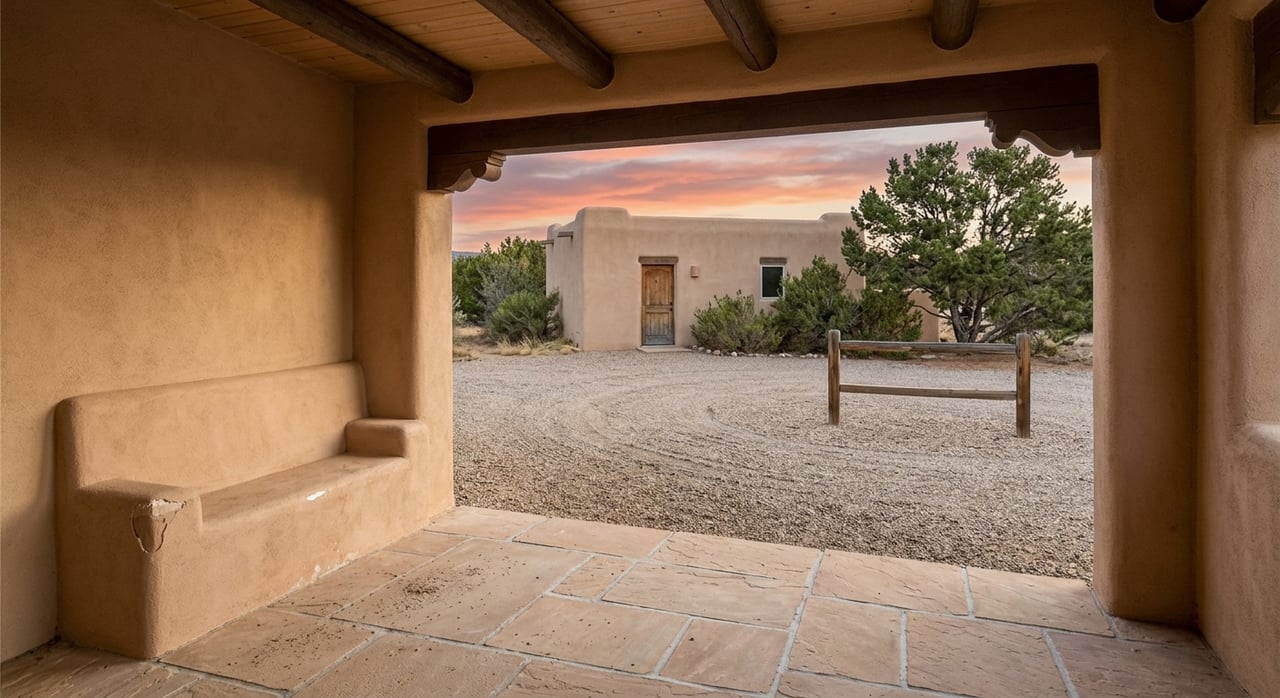
One of the appealing things about Tano Road, Las Dos, and La Tierra is that the architecture is not one-note. Local coverage and listing examples show a mix that includes traditional adobe and Pueblo Revival, Spanish Revival, Territorial, and contemporary homes.
That range gives buyers room to prioritize what matters most. You may find a classic Santa Fe look with earth-toned massing and traditional forms, or a more modern home designed to frame wide views and natural light.
For many buyers in this area, the architecture matters because it shapes how the home sits on the land. On larger parcels, the relationship between house placement, outdoor living, and long-range views is often just as important as square footage.
Roads and Access Need a Close Look
One of the biggest practical differences between properties here is the road experience. Santa Fe County road records show that road surfaces in this area are mixed, not uniformly paved.
Tano Road includes an asphalt maintained section plus a dirt continuation toward Tano West. Camino La Tierra is asphalt, while Old Buckman Road is dirt, and La Tierra subdivision roads include both chipseal and asphalt segments.
Why Access Changes Daily Life
If you are relocating from a more urban or suburban market, this can be easy to overlook. The feel of the drive, the ease of trailer access, and the level of maintenance can all influence how comfortable the property is for year-round use.
When you tour, pay attention to more than the house itself. Notice grade, turning radius, road surface, drainage, and whether the access feels straightforward for guests, service providers, or horse trailers.
Wells, Septic, and Development Matter More Here
In these northwest enclaves, ownership often comes with more infrastructure awareness than buyers expect. Well capacity, septic approvals, grading permissions, and development rules are not side issues. They are central to how the property functions.
Santa Fe County states that new residential development generally requires permits, grading or clearing permits, and authorization before drilling a water-supply well. The county also notes that adding a bedroom requires septic approval from the New Mexico Environment Department, and fences or walls over six feet need permits.
The county land development code also ties minimum lot size to water availability in many districts. If you are comparing parcels, water and hydrology should be part of your due diligence from the start, especially if future improvements are part of your plan.
Property Tax Assumptions Can Be Risky
Horse buyers sometimes assume that owning horses changes how land is valued for property tax purposes. In Santa Fe County, that should be verified carefully.
The county assessor’s grazing forms ask whether land is grazed only by horses and state minimum acreage of 50 acres for grazing in North County and 80 acres in South County. Since many parcels in Tano Road, Las Dos, and La Tierra appear smaller than those thresholds, buyers should confirm valuation status on the specific property rather than assuming horse use changes tax treatment.
Fire Preparedness Is Part of Rural Ownership
These areas offer land, views, and a strong connection to the outdoors, but they also sit in a wildland-urban-interface setting. That means stewardship and preparedness are part of ownership.
The Tano Road Association wildfire booklet, prepared with Santa Fe County and City fire departments, states that the area is served by the Tesuque Volunteer Fire District. It also notes that gated entrances should have Knox-Box access for firefighters.
For buyers, the larger point is not alarm. It is awareness. When you choose more land and a more natural setting, you also take on more responsibility around access, vegetation management, and emergency readiness.
How to Evaluate the Right Fit
If you are comparing Tano Road, Las Dos, and La Tierra, it helps to think in terms of lifestyle first and parcel specifics second. All three can appeal to equestrian and outdoor buyers, but the best fit often depends on how you want to live day to day.
La Tierra may be especially attractive if immediate trail access is high on your list. Tano Road can appeal to buyers looking for a broad mix of parcel sizes, architectural styles, and rural estate character. Las Dos may attract buyers who want larger parcels and a sense of separation, while still staying connected to the northwest Santa Fe lifestyle.
A Smart Buyer Checklist
As you narrow your search, focus on these points:
- Confirm exact parcel boundaries
- Review covenants and easements
- Verify horse allowances on the specific property
- Assess road surface and year-round access
- Check well, septic, and water-related considerations
- Understand what future improvements may require
- Review fire access and preparedness features
That kind of due diligence helps you move beyond the romance of views and acreage into a confident purchase decision.
If you are considering Tano Road, Las Dos, or La Tierra, local guidance can make the search much clearer. These are nuanced properties where land, lifestyle, and logistics all intersect. For tailored insight on equestrian estates, rural homes, and view-driven parcels in Santa Fe’s northwest area, connect with Rachele Griego.
FAQs
What makes Tano Road, Las Dos, and La Tierra different from a typical neighborhood?
- These areas function more like low-density enclaves with multi-acre parcels, varied access, views, and covenants rather than one uniform subdivision layout.
What should horse buyers verify in Las Dos, Santa Fe before making an offer?
- You should confirm horse allowances, easements, covenants, road access, and whether the specific parcel supports your intended use.
How much trail access is available near La Tierra in Santa Fe?
- The La Tierra trail system offers about 25 miles of multi-use trails for hikers, cyclists, and equestrians, with access points that include horse trailer parking.
Are roads in the Tano Road and La Tierra area all paved?
- No, road surfaces are mixed, with some asphalt, some chipseal, and some dirt sections depending on the road and location.
Do larger parcels in northwest Santa Fe make future development easier?
- Not automatically, because lot division, minimum lot size, and future improvements depend on zoning, water availability, and county permitting requirements.
Does owning horses change property taxes on land in Santa Fe County?
- You should not assume it does, because county grazing classification has acreage thresholds and parcel-specific valuation should be verified directly.
