"Canyon Road, I only know one person up there now."
Phil Bové said that this spring, standing ankle deep in leaf litter during the annual cleaning of the ditch his family has tended for two generations. He wasn't being nostalgic for effect. He was describing a fact: the street he grew up on, one of the most photographed in Santa Fe, has quietly changed hands around him while the ditch that runs behind it kept doing exactly what it has done since before Santa Fe had a name that stuck.
Most descriptions of Historic Eastside treat the Acequia Madre as atmosphere: cottonwoods, a dirt path, a nice place to walk a dog past adobe walls. That's true as far as it goes, but it undersells what the ditch actually is. The Acequia Madre is a governed water system with a mayordomo, a fee schedule, an annual work obligation, and a membership roll. As of this spring's cleaning, that roll stood at forty-seven parciantes, the households who hold water rights along its seven-mile run. Two years earlier, at the 2024 cleaning, the count was forty-four. Both years, organizers described the same thing Bové described to KSFR: a neighborhood where fewer of the old families are left, and yet the number of people formally tied to the ditch keeps climbing.
That's the part worth sitting with before the walk itself. The obvious story about an old irrigation system in a gentrifying neighborhood is decline. The actual story here is closer to the opposite.
How the Roll Grew While the Neighbors Changed
Reporting on the ditch's history traces its user count back to the 1970s, when roughly sixteen people were actively irrigating from it. That number has climbed since, and not because more descendants of the original farming families stayed put. The Acequia Madre Association secured a permit that lets water rights holders lease their turns to new parciantes rather than let them lapse. In practice, that means someone who buys a house on or near the ditch today can, in many cases, buy into a four-hundred-year-old legal system that the house's previous owners were part of. The membership didn't shrink as the old guard moved on. It absorbed new households in their place.
Phil Bové put the mechanism plainly when he talked to El Palacio about why any of this still functions at all: "The reason acequias continue to operate is a few people will just work hard at it." He would know. He served as a commissioner for close to fifty years before stepping back this year, handing the role toward a younger generation that includes his daughter, Miche Bové Garcia. The current mayordomo, Eric Montoya, opened this year's cleaning with a blessing, the same way his predecessors have for as long as anyone remembers, and told KSFR he intends to keep doing it until he can't, then pass the knowledge to his own kids the way it was passed to him.
So the institution persists on two tracks at once. The leadership stays in a small number of families who treat the role as inherited work. The membership below that leadership keeps turning over as the neighborhood does. Both things are true, and neither cancels the other out.
What You're Actually Walking Past
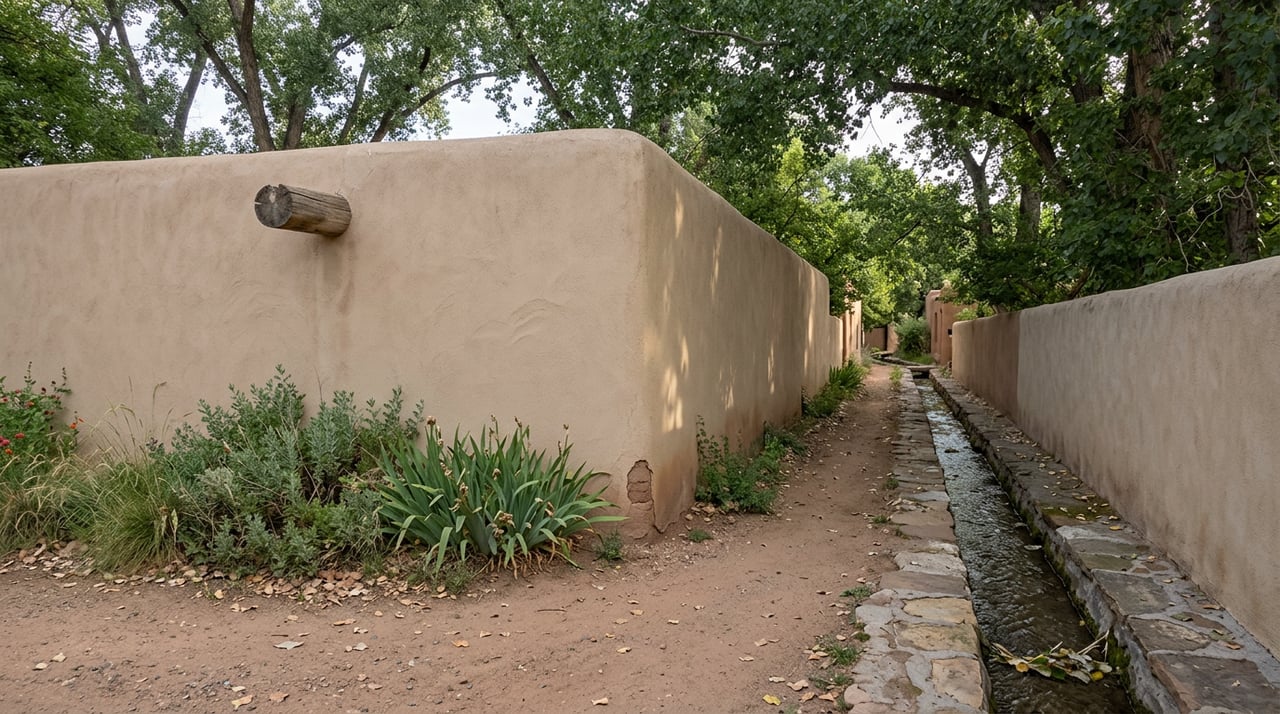
If you live on or near Acequia Madre, you already know the physical route even if you've never thought about what's governing it. Starting near the Garcia Street end and heading east, the dirt path runs under mature cottonwoods with the ditch itself cut into the ground beside it, stone-lined in places, no more than a few feet across. A short detour down Gormley Lane takes you behind Nuart Gallery, which occupies a building that served as one of the neighborhood's working grocery stores in the early 1900s before Canyon Road turned residential storefronts into gallery space. Keep going and the lane loops into Gypsy Alley, past the small shops tucked into what used to be private homes, before rejoining the ditch path.
Further along sits 614 Acequia Madre, a 1926 Territorial Revival house built by three generations of one family, Eva Scott Fényes, her daughter Leonora Scott Muse Curtin, and her granddaughter Leonora Frances Curtin Paloheimo. It's on the National Register as a contributing building in the Camino del Monte Sol Historic District, and it now houses the Women's International Study Center. In 2022, a George Rodrigue sculpture, one of his blue dog pieces, was installed in the garden. You can see it through the fence if you know to look. Down one of the side lanes off the main path, there's a redwood tree that has nothing to do with the high desert around it and everything to do with someone, at some point, deciding to plant one anyway.
The path eventually meets Patrick Smith Park, where the ditch runs alongside the Santa Fe River, and where the neighborhood's kids play on the same ground their grandparents did. Acequia Madre Elementary, the public school named for the street, still runs a Pet Parade for the Fiestas de Santa Fe each fall, dogs and cats and the occasional bird walking a few blocks with their kids.
None of this is hidden, exactly. It's just easy to walk past without registering that the ditch connecting all of it has a legal identity separate from the pretty scenery it produces.
The One Day a Year It Asks Something of You
The Historic Santa Fe Foundation describes the obligation plainly: property owners with water rights along the acequia pay an annual fee and are responsible for keeping their section clear of debris each spring, a job known as the limpieza y saca de acequia. This isn't a suggestion. It's the terms of membership, and it's the one point in the year when the system asks something of its members beyond a check.
This spring's cleaning drew volunteers of every description, according to KSFR's coverage. Pitu Martín, a thirty-year resident, was there for her eighth consecutive year, raking out the leaves and sticks that compress into clogs over winter. Her yard is small, she said, just some trees and irises, not a working farm by any stretch. She still shows up. So do kids who've never seen the ditch run at anything like historic volume, and retirees who remember when it did.
A version of the same story is playing out a few blocks away at the Randall Davey Audubon Center, where the garden curator is replanting sections of lawn with native grasses because the old cottonwoods along the property's stretch of Acequia del Llano, one of only three other acequias still flowing inside city limits alongside the Madre, are reaching the end of their natural life. The trees that shade these walks won't last forever. The people who maintain the system around them are already planning for what replaces them.
Why This Matters If You Live Here
If your house sits along the ditch, you are very likely already a parciante whether or not you've ever irrigated a single fruit tree from it. That comes with the annual fee and the spring obligation, and it's worth understanding before you assume the ditch behind your wall is purely decorative. It isn't. It has rules, a hierarchy, and a waiting logic that has kept it functioning for over four centuries while almost everything else on the street changed hands.
The walk you already take, whether it's a morning loop before work or an evening stroll with the dog, follows the exact boundary of that governed system. The gallery in the old grocery building, the sculpture behind the garden fence, the redwood that shouldn't be there, the school with the Pet Parade, all of it sits inside the same forty-seven-household roll that Eric Montoya opened with a blessing this April. Knowing that doesn't change the walk. It changes what you're looking at while you take it.
If you're weighing a move into Historic Eastside, or already own here and are curious what a property's specific water rights history looks like, Rachele Griego has spent years working inside these details, not just the postcard version of them. Let's connect. Your questions about this neighborhood deserve real answers, not the same four paragraphs every other site repeats.
