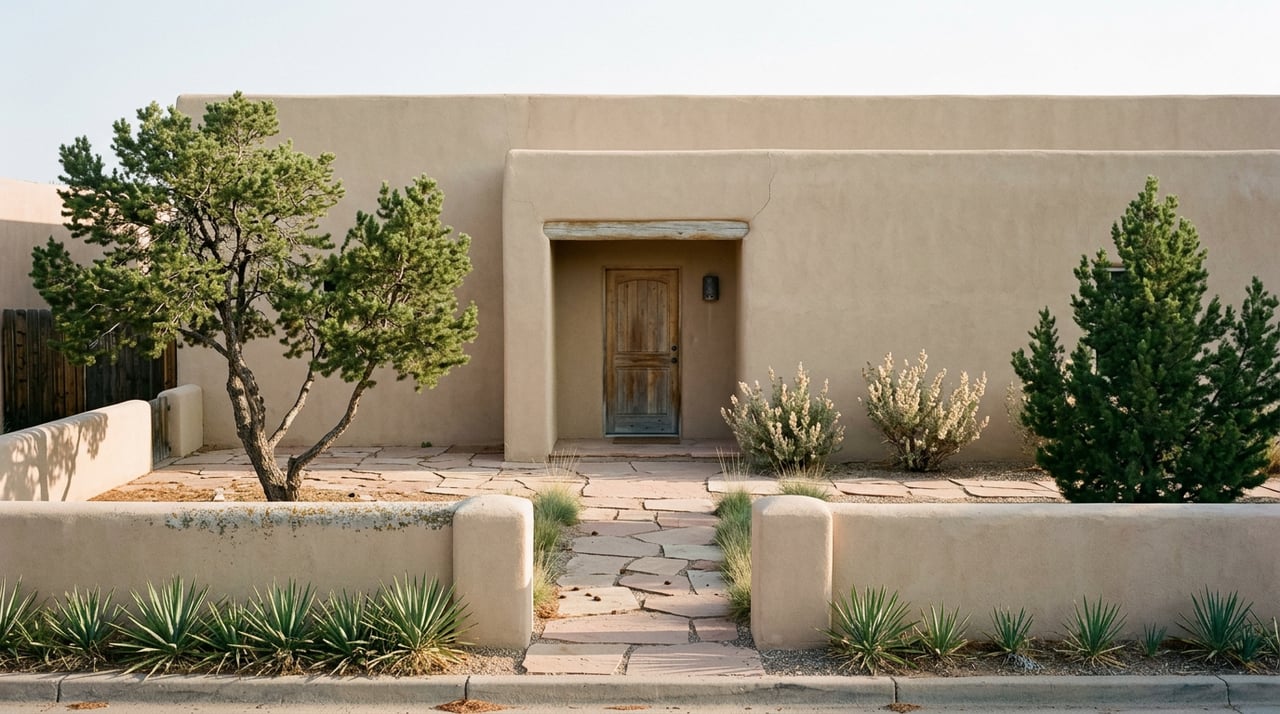
Walk south from the Roundhouse on any of the streets that fan out toward Cordova Road and you are, by every local convention, in South Capital. The sidewalks are the same width. The trees lean the same way over the same broad streets. A real estate listing will call the whole stretch "historic" without blinking. But cross Houghton Street, or drift west past Don Cubero, and you have quietly left the one piece of South Capital that actually carries federal historic status, as [Wikipedia's entry on the Don Gaspar Historic District](https://en.wikipedia.org/wiki/Don_Gaspar_Historic_District) notes. The district also has a design review board. The boundary is not marked by a sign; check the City's map before planning exterior work.
This matters more than it sounds like it should, because the difference between "inside the district" and "just outside it" is the difference between street-visible exterior work that needs pre-approval and work that doesn't.
One Neighborhood, Two Rulebooks
The Don Gaspar Historic District was listed on the National Register of Historic Places in 1983 and covers 278 contributing buildings, a mix of Pueblo Revival, California Bungalow, and late-period Victorian homes that went up as the railroad brought new materials and new tastes into a town that had, until then, built almost exclusively in adobe. Its boundary is specific: Paseo de Peralta to the north, Old Santa Fe Trail to the east, Houghton Street to the south, and Don Cubero, approximately, to the west.
South Capital, as buyers and agents use the term day to day, is bigger than that. Most descriptions of the neighborhood push the southern edge down to Cordova Road and the western edge out toward St. Francis Drive or Galisteo Street, well past where Don Gaspar's official boundary stops. The two footprints overlap almost entirely at the north end, near the Capitol, and diverge steadily as you move south and west. A home a few blocks into that outer stretch sits in South Capital by every local reference and outside the National Register district by the City's own maps.
That gap is not trivia. It is the line that determines whether street-visible exterior work needs pre-approval or not.
What the Review Board Actually Looks At
Santa Fe's building permit process treats work inside its five historic districts differently from everywhere else. Any exterior remodeling of a feature visible from a public street, way, or public place inside a historic district requires pre-approval from the City's Historic Preservation Division before a permit is issued. The Historic Districts Review Board meets on the second and fourth Tuesday of each month, according to the [City of Santa Fe's Historic Preservation Division](https://santafenm.gov/land-use/historic-preservation). The standard runs deeper than most buyers expect. The [City of Santa Fe](https://santafenm.gov/media/files/public_works/Application_for_Permit_for_Excavations_Street_Cuts_Restorations_Ch_23-2.pdf) requires new concrete work anywhere in a historic district, including sidewalk and driveway pours, to be a pre-approved color other than plain gray. That is the level of granularity a Don Gaspar homeowner lives with for anything the street can see.
None of that applies to interior work, and none of it applies to a home that sits outside the district's boundary in the first place, regardless of how old or Santa Fe-style it looks from the sidewalk.
What a 1955 South Capital Remodel Actually Proves
The Santa Fe Area Home Builders Association's 2026 Remodelers Showcase featured a renovation of a 1955 South Capital home that the owners felt needed real updating to work for modern life. Tierra Concepts led the project, working with Erica Ortiz Berke of Neubleu Interior Design on the aesthetic direction. The scope was not cosmetic. Zachary & Sons installed traditional Saltillo tile through the open-concept living room, dining room, and kitchen, plus the primary bedroom and two bathrooms. Every interior door was replaced with custom carved doors by Vince Neal of VLM. Dark walnut cabinetry came from Albuquerque's Ernest Thompson. The kiva fireplaces were restored and the walls redone in traditional diamond plaster by Javier's Lath and Plaster.
That is a full reimagining of a house's interior, and it is exactly the kind of project that proceeds the same way whether the address sits inside the Don Gaspar boundary or three blocks south of it. Interior tile, cabinetry, doors, plaster, and fireplace work are not the exterior features subject to public view that trigger Historic Preservation Division review. A buyer looking at a dated South Capital house with an eye toward this kind of transformation has roughly the same runway across most of the neighborhood.
Where the Boundary Matters
The boundary starts to matter the moment a project turns to the parts of a house the street can see. An addition that changes the roofline, a new run of street-facing windows, a fence or wall replacement, a change to stucco color or texture, a second story where there wasn't one before: any of these, on a parcel inside Don Gaspar's boundary, means a Historic Preservation Division application first before a building permit gets issued. The same project on a parcel outside that boundary, even one that reads as classic South Capital in every listing photo, moves through the City's standard permit process without that layer.
The word "historic" in a South Capital listing description does not establish whether a parcel is within the Don Gaspar boundary. A house's age and style tell you almost nothing about which rulebook governs its next remodel. Its parcel location relative to Paseo de Peralta, Old Santa Fe Trail, Houghton Street, and Don Cubero tells you everything.
Before You Assume Your Renovation Plan Works
A few things worth confirming before you write an offer with a specific renovation in mind, or before you market a South Capital listing around its "potential":
- Check the parcel against the City's Historic Districts and Historic Buildings Status map layers before assuming either way. Street name alone is not reliable near the boundary streets.
- If the home is inside Don Gaspar, ask whether the Santa Fe Land Development Code classifies it as significant, contributing, or noncontributing.
- Separate your renovation wish list into interior and exterior work early. Interior gut jobs, like the 1955 remodel Tierra Concepts completed, rarely need historic review no matter where the house sits. Anything visible from the street is where the boundary decides your timeline.
- If exterior work is part of the plan and the parcel is inside the district, build in time for the Historic Preservation Division's application process.
- Do not assume a neighborhood guide's boundary description is the legal one. Most describe South Capital as extending well past Houghton Street to Cordova Road, which is accurate for the neighborhood but not for the historic district inside it.
A Few Questions Worth Asking
Does being outside the Don Gaspar district mean I can build whatever I want? No. Standard City zoning, setback, and permitting rules still apply everywhere in Santa Fe. What changes outside the district is the extra layer of Historic Preservation Division review for street-visible exterior work.
If my house is inside the district, can I still do a full interior renovation without a hearing? Generally yes. The review authority is tied to exterior features visible from a public street, way, or place. Interior work like the tile, cabinetry, doors, and plaster in the 2026 Remodelers Showcase project falls outside that scope.
How do I find out which side of the line a specific address falls on? The City of Santa Fe's Historic Preservation Division maintains the map layers and application process for all five historic districts, and their office can confirm a parcel's status directly.
If you are weighing a South Capital purchase with renovation in mind, or getting a South Capital home ready to list, the boundary question is worth settling before the design plans get too far along. Rachele Griego works this neighborhood block by block, not just by the name on the listing, and can help you find out which rulebook actually applies to the house you're considering. Let's connect — start your Santa Fe journey.
This article is general information, not legal, tax or financial advice. Consult a qualified professional about your situation.
